Do people really shop across channels?
Yes, and for many it’s the default. In a Periscope by McKinsey consumer survey across the U.S., the UK, Germany and France, 60% or more of shoppers in Germany, the UK and the US said they engage equally with online and offline channels. France was the exception, with 35% shopping across both. (Multi-country survey; results vary by market.)
60%+ of consumers engage equally with online and offline channels — Periscope by McKinsey (U.S., UK, Germany)
A Harvard Business Review study of more than 46,000 shoppers at a large U.S. retailer found the same pattern: only 7% shopped exclusively online and 20% only in store. Everyone else moved between channels. (One U.S. retailer, data from 2015–2016.)
Are omnichannel shoppers worth more?
In that study, yes. Omnichannel customers spent on average 4% more per store visit and 10% more online than single-channel customers. Within six months, they also made 23% more repeat trips to the retailer’s stores and were more likely to recommend the brand.
+10% online spend, +4% in store, +23% repeat trips for omnichannel shoppers — Harvard Business Review (U.S. retailer study)
The study also found that shoppers who researched online before visiting spent 13% more in store. Research online isn’t lost traffic. It’s preparation for the purchase.
Where does the experience break?
Between channels. A customer explores a sofa online, sees one set of photos, visits the store, finds a different display, then tries to picture a fabric that isn’t on the floor. Back home, the website shows only a few finishes. Each step uses different content, so the product never feels like the same product. That friction is where decisions stall.
How does one digital twin fix it?
By making the product itself the constant. When a single 3D model powers every touchpoint, the customer sees the same product, the same finishes and the same proportions everywhere:
- Online: they rotate and configure it on the product page.
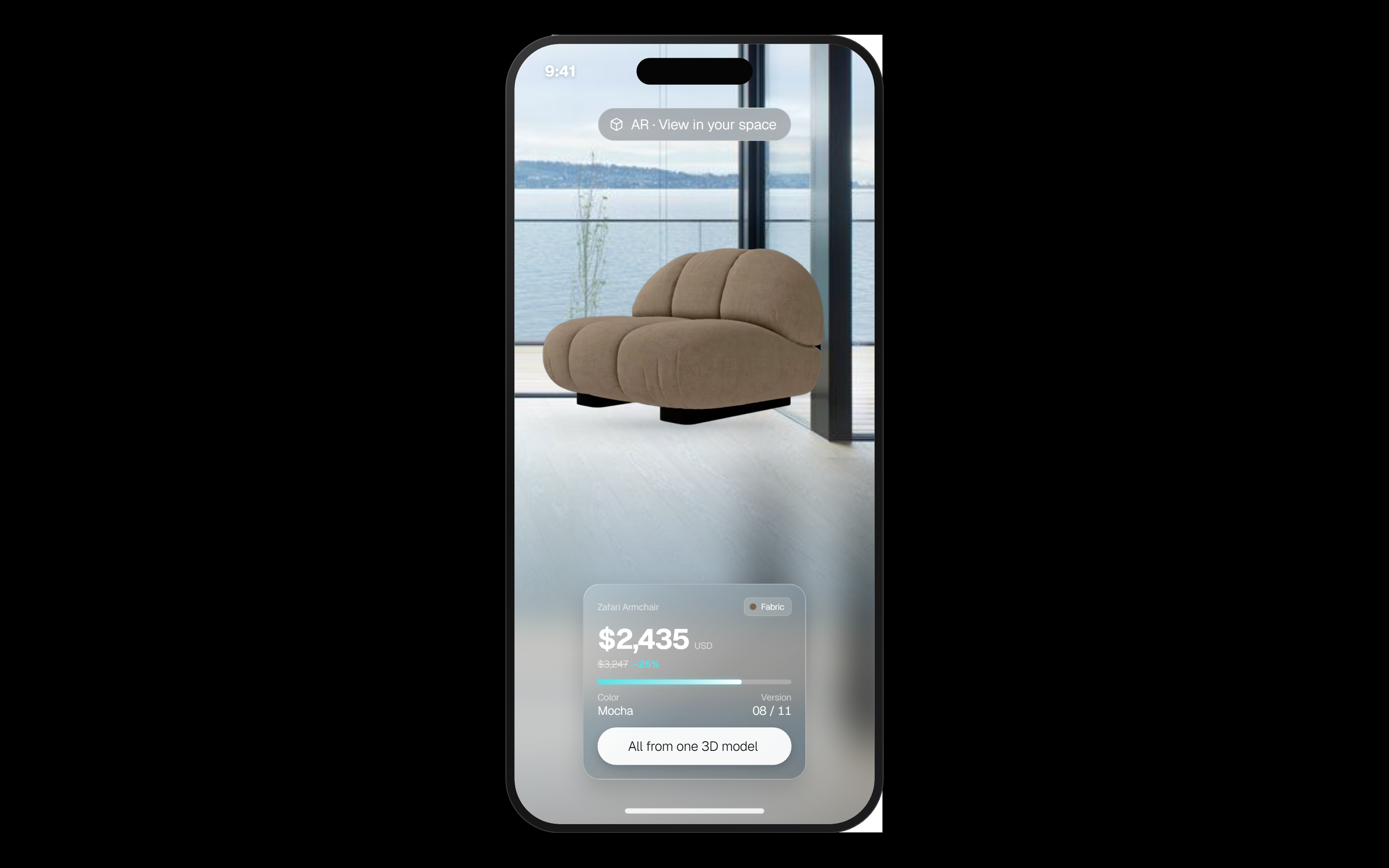
- At home: they place it at true scale in their own space with AR, no app needed.
- In store: the same 3D product runs on a screen, so staff can show every fabric and configuration, even the ones that aren’t on the floor.
- Back online: they find exactly the version they built, ready to buy
The channel changes. The product doesn’t.
One store, everywhere
This is the “online and in-store” part of Ardata. From one digital twin, the platform delivers 3D configurators, AR at true scale, AI imaging, photorealistic visuals and one asset library, running inside the store the brand already uses and on the screens it puts in front of customers. Ardata works alongside the ecommerce, marketing and retail teams so the experience is easy to find and consistent at every step, and every interaction becomes data about what customers want.
Online and in-store were never two stores. They’re one customer. One intelligent platform. Endless ways to experience your products. 3D, AR & AI, online and in-store.
Does the product look the same on the website, at home and in the store? See how Ardata connects all three.