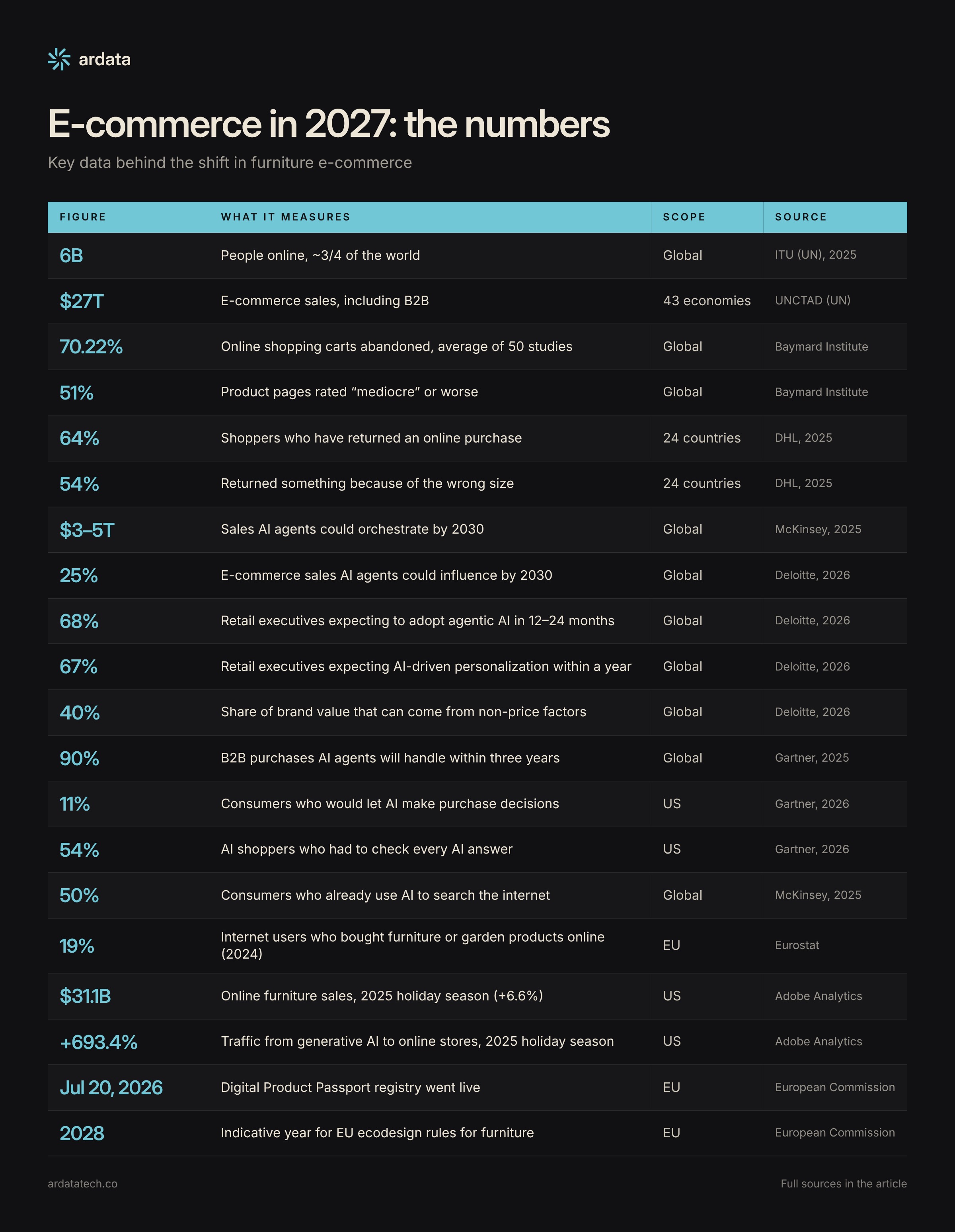
The market is the world. About 6 billion people are online, roughly three-quarters of the planet, according to the ITU, the United Nations agency for digital technology. UNCTAD, the UN trade agency, estimates e-commerce sales at $27 trillion across 43 economies, including business-to-business. Furniture is part of that shift: in the EU, 19% of internet users bought furniture or garden products online in 2024, according to Eurostat, and in the US online furniture sales reached $31.1 billion in the 2025 holiday season, according to Adobe Analytics.
But most visits still end without a sale. Baymard Institute (an ecommerce user-experience research institute) puts the average cart abandonment rate at 70.22%, across 50 studies, and rates 51% of product pages as "mediocre" or worse. After the sale, the problem continues: in a DHL survey of 24,000 shoppers in 24 countries, 64% had returned an online purchase, and 54% had returned something because of the wrong size.
So what will it take to compete in 2027? The biggest names in research point to four things:
1. Be ready for AI agents. McKinsey (a global management consulting firm) estimates AI agents could orchestrate $3 to 5 trillion in global retail sales by 2030. Deloitte (a global consulting and audit firm) says agents could influence up to 25% of global e-commerce sales by 2030, and 68% of the 330 retail executives it surveyed expect to adopt agentic AI within 12 to 24 months. In business purchasing, Gartner (a technology research and advisory firm) predicts AI agents will handle 90% of B2B purchases within three years. Agents read data, not photos: real measurements, materials, modules and price per version.
2. Show, don't ask for trust. People want AI's help, but not its final word. In a 2026 Gartner survey of US consumers, only 11% would let AI make purchase decisions, and 54% of those who shopped with AI had to check every answer. In 2027, the product itself has to be the proof: the exact piece, at real size, in the exact finish.
3. Make it personal. Deloitte reports that 67% of retail executives expect to have AI-driven personalization within the next year, and that up to 40% of how people value a brand comes from non-price factors like quality, service and an easy checkout. In furniture, personal means choosing the fabric, the module and the layout yourself.
4. Treat product data as infrastructure. The EU Digital Product Passport registry went live on July 20, 2026, and furniture is one of the four priority groups in the EU's ecodesign plan, with rules expected around 2028. Product information has to be complete, organized and connected to every channel.
How Ardata helps:
At Ardata, everything starts with a 3D model, the digital twin of each product. From that one model we build custom solutions, according to what each brand is looking for:
- 3D viewer: every angle and every finish, with real measurements
- Configurators: fabrics, colors and options that change live, with the price updated at every step
- Modular configurators: customers build their sofa piece by piece, and only combinations that can be made are allowed
- 3D room planners: customers place and arrange pieces in their own layout before buying
- Augmented reality: the exact piece at real size in their room, straight from the browser. No app
- AI: product images and scenes generated from the same model, and product data structured so AI tools can understand it
One model feeds the website, the in-store screens, the catalog and, when the time comes, the digital passport. Build it once, use it everywhere.
2027 rewards the brands whose products can be seen, configured and understood, by people and by machines. One intelligent platform. Endless ways to experience your products. Turn your catalog into digital twins. Everything your ecommerce needs to showcase its products: 3D, AR and AI in one platform, online and in-store. One 3D model per product, ready for configurators, modular builders and 3D planners. Have something in mind? We build custom interactive solutions around it.
Sources: ITU (UN); UNCTAD (UN); Baymard Institute; DHL, 2025 E-commerce Returns Trends; McKinsey, The agentic commerce opportunity (2025); Deloitte, Global Retail Industry Outlook 2026; Gartner (2025, 2026); Eurostat; Adobe Analytics, 2025 Holiday Shopping Season; European Commission.