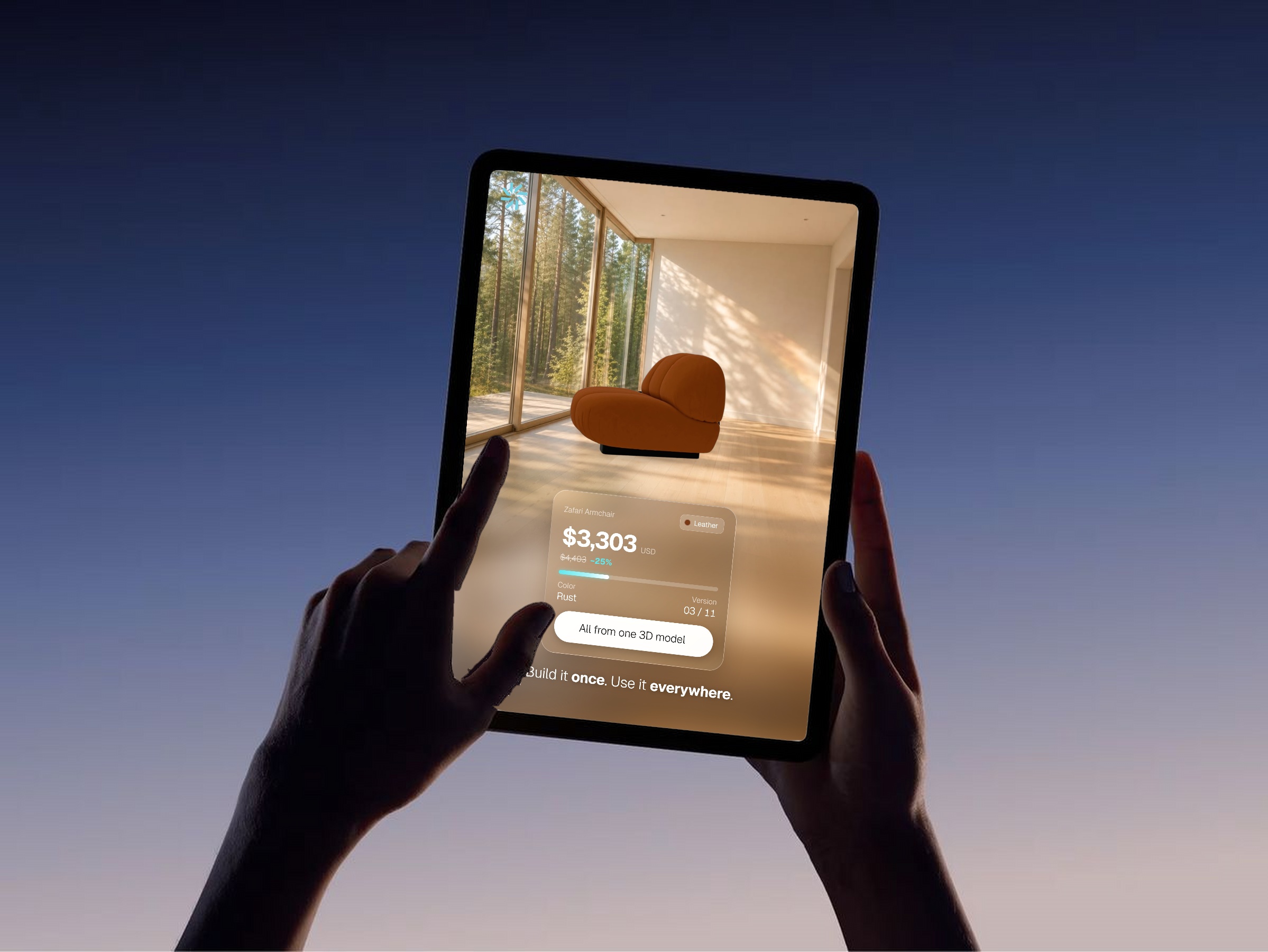
What does a static product page tell you?
Very little. A team can see visits, clicks and orders. What it can’t see is the decision behind them: which color the shopper hesitated on, whether size was the doubt, or why someone spent two minutes on a sofa and left. A flat photo talks to the customer, but it doesn’t listen back.
What does an interactive product reveal?
Intent. When the product can be explored, behavior becomes visible:
- Variants chosen: which fabrics, finishes and configurations people build most often.
- AR sessions: who placed the product in their own space, one of the strongest signals of purchase intent.
- 3D views: which products people stop to explore, not just scroll past.
- Most-viewed items: where attention concentrates across the catalog.
That’s the difference between knowing what sold and understanding what customers were looking for.
Why does this kind of data matter now?
Because customers expect brands to know them. McKinsey found that 71% of consumers expect companies to deliver personalized interactions, and 76% get frustrated when that doesn’t happen. Its research also shows personalization most often drives a 10% to 15% revenue lift.
71% of consumers expect personalized interactions — McKinsey (global consumer research)
The challenge is getting the data to do it. In Voyado’s Inside E-commerce 2026 report, 57% of ecommerce leaders said first-party data will be at the heart of personalization in 2026, yet only 10% said their personalization is truly data-driven. (survey of ecommerce leaders by Voyado, a European CX platform) The gap isn’t intention. It’s having real signals about what customers want.
What can a team do with it?
Make better decisions, faster:
- Product and buying: see which finishes and configurations are most chosen before deciding what to stock or produce.
- Marketing: build campaigns around the variants and products people already engage with most.
- Merchandising: highlight in-store and online the items that attract the most attention.
- The experience itself: spot where shoppers hesitate and fix it.
Online and in-store, one picture
McKinsey describes what customers expect in simple terms: to be known no matter where they interact with a brand. When the same digital twin powers the product page and the screens in store, the interaction data comes from one source, not from disconnected tools.
The living catalog listens
This is the intelligent part of Ardata. From one digital twin, the platform delivers 3D configurators, AR at true scale, AI imaging, photorealistic visuals and one asset library, running inside the store the brand already uses. And its built-in analytics show how customers interact with each product: 3D views, AR sessions, the variants they choose and the most-viewed items. Ardata works alongside the marketing and ecommerce team so that data turns into decisions, not just dashboards.
A static catalog talks. A living catalog listens. One intelligent platform. Endless ways to experience your products. 3D, AR & AI, online and in-store.